

Beyond Application Retirement: Why Enterprise Data Governance Platforms Are Replacing Legacy Archiving Tools
Executive Overview
Enterprise data archiving is at an inflection point.
For years, organizations relied on database archiving tools and application retirement specialists to shut down legacy systems, reduce infrastructure costs, and meet compliance requirements.
Vendors such as IBM (InfoSphere Optim), OpenText, Archive360, Data Migration International (JiVS), Infobelt, and Platform 3 Solutions have each built credible solutions within this space.
But as enterprises accelerate cloud modernization and AI adoption, the market is revealing a structural truth:
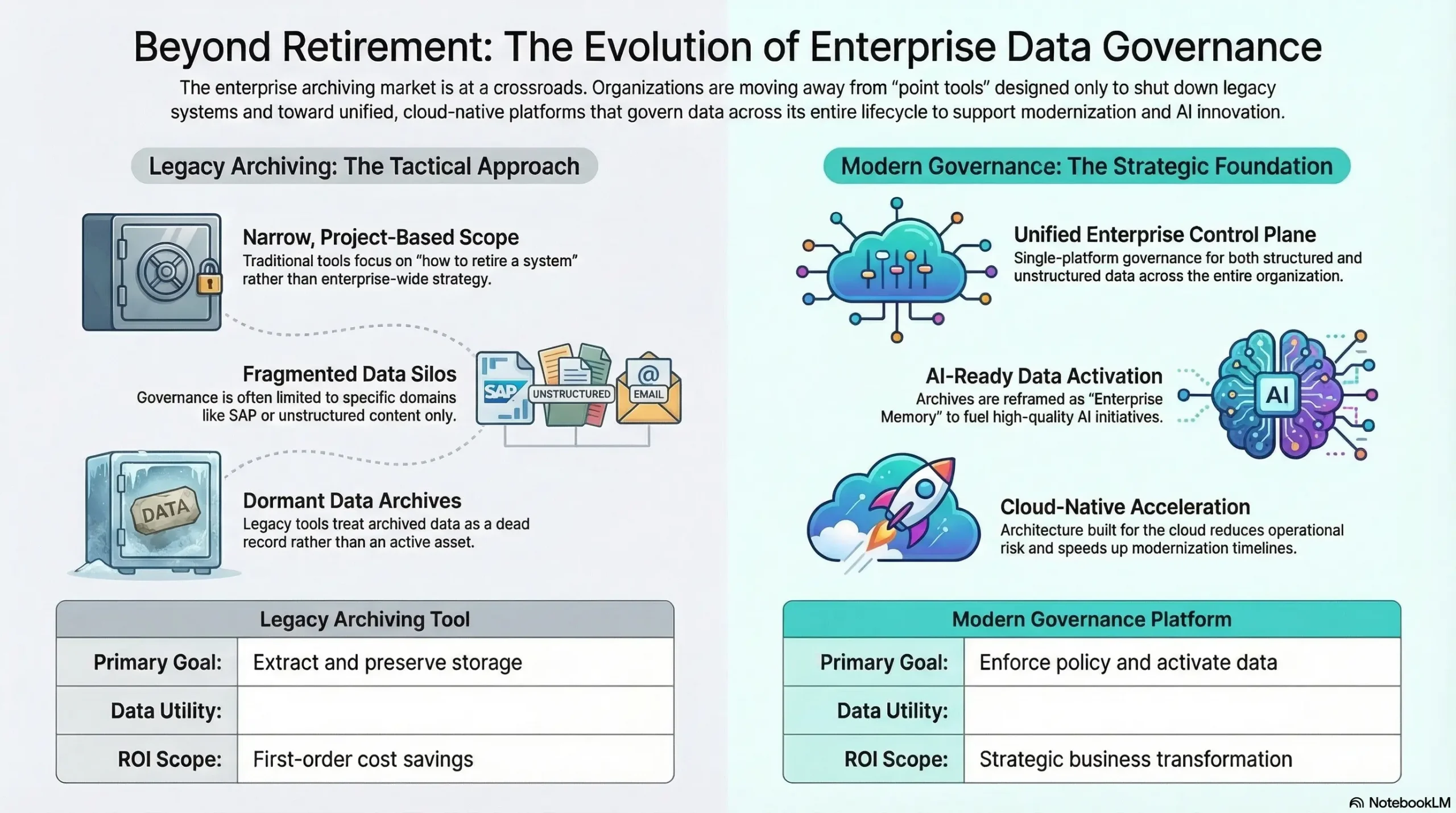
Point archiving tools are no longer sufficient.
The future belongs to unified, cloud-native enterprise data governance platforms.
The Competitive Reality: Strong Capabilities, Narrow Scope
Each major competitor has legitimate strengths.
IBM Optim delivers deep structured extraction and referential integrity preservation.
- OpenText dominates SAP-centric compliance environments.
- Archive360 leads with SaaS-first governance for unstructured data.
- JiVS emphasizes cost-driven application retirement.
- Infobelt and Platform 3 Solutions specialize in ERP shutdown efficiency.
These vendors solve specific retirement challenges effectively.
However, they share a common architectural constraint:
They approach archiving as a project-based event, not as an enterprise-wide governance strategy.
That limitation becomes visible when organizations attempt to scale beyond a single system or domain.
The Structural Weakness in the Market
Modern enterprises face challenges that extend far beyond system shutdown:
- Cross-application data governance
- Hybrid cloud complexity
- Unified metadata authority
- AI model enablement
- Enterprise-wide retention enforcement
- Long-term architectural flexibility
Most incumbent solutions were designed to answer:
“How do we retire this system?”
They were not designed to answer:
“How do we govern enterprise data across its entire lifecycle — and activate it for future value?”
That distinction defines the strategic gap.
The Shift From Tool to Platform
A tool extracts data.A platform governs it.
A tool preserves storage. A platform enforces policy.
A tool shuts systems down. A platform establishes enterprise data authority.
This is where Solix Technologies differentiates itself.
Rather than operating as a point retirement vendor, Solix positions its solution as a:
Cloud-native enterprise data platform built for structured and unstructured lifecycle governance, application retirement at scale, and AI-ready data activation.
Cloud-Native Architecture: Not an Add-On, but a Foundation
Many competitors originated in on-premise environments and later introduced cloud compatibility.
Solix’s architecture emphasizes:
- SaaS-ready deployment
- Elastic object storage
- Cloud-optimized scalability
- Reduced infrastructure dependency
- Lower services intensity
In large enterprise environments, services-heavy deployment models slow modernization and increase long-term operational risk.
Cloud-native design accelerates time-to-value while reducing architectural friction.
This matters significantly in multi-year modernization programs.
Governance Across Domains — Not in Silos
A recurring limitation in the competitive landscape is governance fragmentation.
Some vendors excel in SAP data.
Others in unstructured content.
Others in ERP retirement.
But enterprises rarely operate in isolated silos.
Solix introduces:
- A unified metadata layer
- Cross-domain retention enforcement
- Policy-driven lifecycle orchestration
- Structured and unstructured data coverage
- Centralized governance visibility
This establishes a true enterprise data control plane — not a collection of disconnected archiving tools.
Activating Structured Data for AI
One of the most underleveraged assets in enterprises is archived structured data.
ERP systems, financial ledgers, operational databases — these datasets represent the most reconciled and trusted historical record of the business.
Traditional archiving tools preserve this data but treat it as dormant.
Solix reframes archived structured data as:
Enterprise memory — governed, trusted, and AI-ready.
By maintaining referential integrity and structured accessibility, historical data becomes available for:
- Advanced analytics
- AI model training
- Predictive forecasting
- Compliance intelligence
- Strategic decision support
In an era where AI initiatives depend on high-quality data, this capability becomes a decisive differentiator.
Economic Advantage Beyond Cost Reduction
Most retirement-focused vendors lead with cost savings:
- License elimination
- Storage reduction
- Infrastructure shutdown
While important, these are first-order savings.
Solix expands the ROI narrative to include:
- Infrastructure consolidation
- Reduced services dependency
- Governance risk mitigation
- Analytics value extraction
- AI enablement without re-platforming
This elevates archiving from an operational cleanup to a strategic transformation initiative.
How Executive Buyers Evaluate the Market
At the CIO and CDO level, decision criteria are evolving.
Executives now evaluate vendors based on:
- Governance scalability
- Cloud-native architecture
- Cross-domain data control
- AI-readiness strategy
- Enterprise-wide policy enforcement
- Long-term modernization alignment
In this context:
IBM remains strong in database archiving. OpenText remains strong in SAP compliance. Archive360 remains strong in SaaS governance for content. JiVS remains strong in cost-driven retirement. Infobelt and Platform 3 remain strong in ERP shutdown execution.
But Solix positions itself as something broader:
The enterprise data foundation that governs, retires, activates, and future-proofs structured data at scale.
The Strategic Imperative
The enterprise archiving market is no longer about simply turning systems off.
It is about establishing long-term data authority.
Organizations that rely exclusively on narrow retirement tools risk:
- Governance fragmentation
- Data silos
- Limited AI enablement
- Architectural rigidity
- Repeated project cycles
Organizations that adopt unified data lifecycle platforms gain:
- Enterprise-wide governance consistency
- Cloud-native scalability
- Structured data activation
- AI readiness
- Strategic modernization alignment
Conclusion: The Market’s Next Phase
Enterprise data management is moving into its next phase.
The conversation is no longer:
“How do we retire this legacy application?”
It is:
“How do we establish enterprise-wide data control that supports modernization, governance, and AI-driven innovation?”
Vendors built for retirement projects will continue to serve tactical needs.
Platforms built for enterprise governance will define the strategic future.
As enterprises modernize their architecture and accelerate AI initiatives, the choice becomes clear:
Retire systems — or build an enterprise data foundation.
