

The Evolution of Enterprise Archiving: Why Point Solutions Are No Longer Enough
Introduction: The Market Is Shifting
Enterprise data archiving and application retirement were once considered tactical IT projects. Organizations shut down legacy systems, extracted the data, stored it for compliance, and moved forward.
But today, the landscape has changed.
Cloud modernization, AI adoption, regulatory expansion, and cross-application governance demands have transformed archiving into a strategic board-level initiative.
Vendors such as IBM (InfoSphere Optim), OpenText, Archive360, Data Migration International (JiVS), Infobelt, and Platform 3 Solutions each bring credible strengths to the market. However, most are fundamentally positioned as retirement tools, not enterprise-wide data governance platforms.
The Current Competitive Landscape
IBM (InfoSphere Optim)
IBM has long been recognized for deep structured data extraction and referential integrity preservation. Optim performs well in database archiving scenarios, particularly in complex relational environments.
However, its architecture reflects legacy on-premise roots. Deployments can be services-intensive, and archiving is not positioned as a forward-looking cloud-native strategic data foundation.
OpenText
OpenText excels in compliance-heavy environments, particularly within SAP ecosystems. Its brand strength and enterprise search capabilities are well established.
Yet its positioning is largely SAP-centric and compliance-led. The broader multi-domain governance and AI-ready structured data narrative is less emphasized.
Archive360
Archive360 brings strong SaaS-first positioning and governance-forward messaging. It performs well in unstructured content governance and cloud-native deployments.
However, its depth in complex structured database retirement and large-scale ERP decommissioning is comparatively lighter.
Data Migration International (JiVS)
JiVS focuses on cost optimization and flexible cloud deployments. It is particularly strong in European markets and application retirement economics.
But its positioning centers more on cost reduction than enterprise-wide data governance and AI enablement.
Infobelt & Platform 3 Solutions
Both vendors demonstrate strength in ERP and SAP system shutdown initiatives. Their value proposition centers on efficient legacy retirement.
However, they are typically project-based solutions rather than unified data governance platforms.
The Structural Limitation: Tool-Based Thinking
Across the competitive field, a common pattern emerges.
Most vendors frame the conversation around:
- Retiring a specific system
- Extracting structured data
- Reducing maintenance cost
- Meeting compliance requirements
These are legitimate needs.
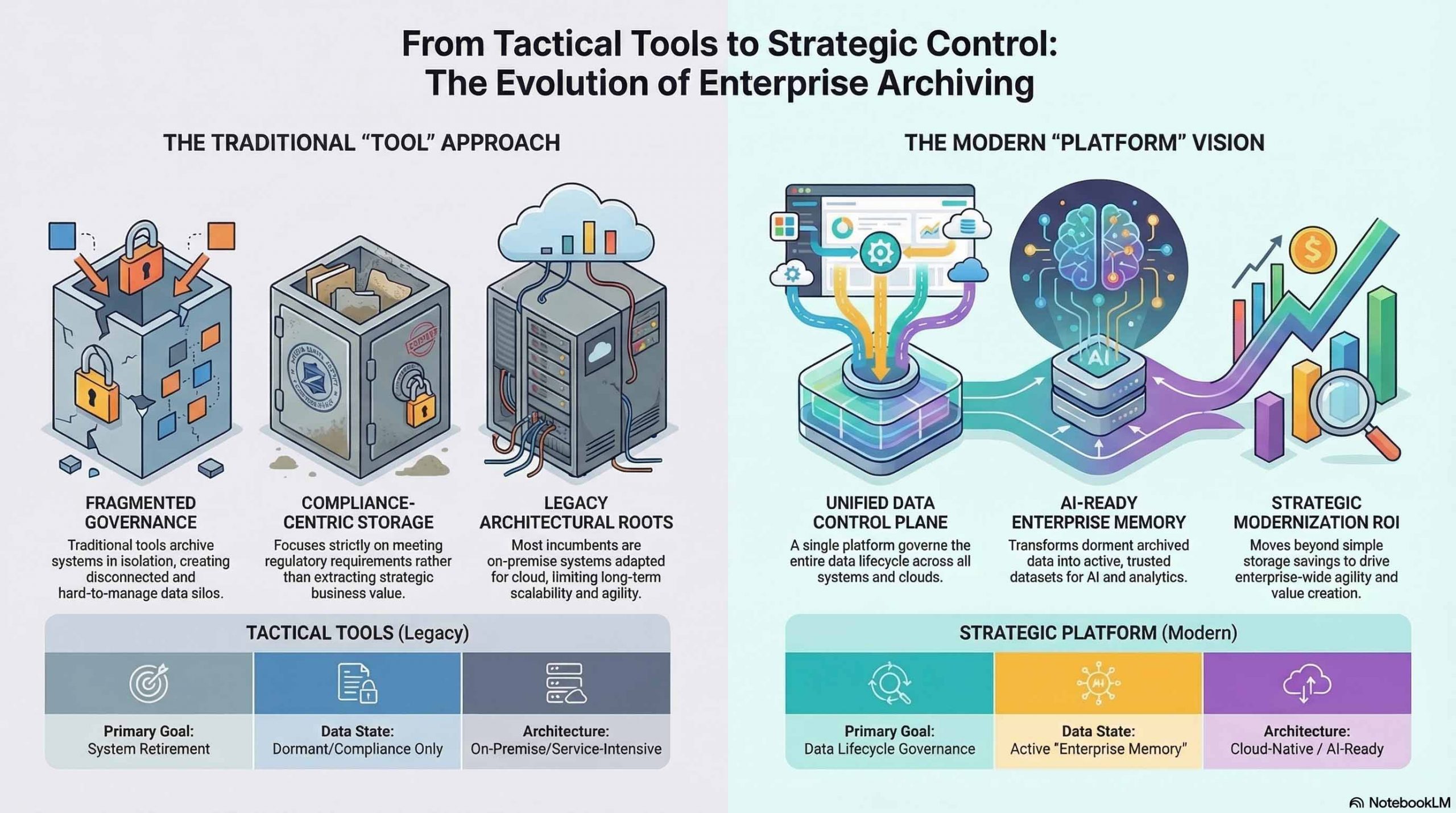
But they are tactical outcomes — not strategic architecture.
Modern enterprises operate across:
- Hundreds of applications
- Hybrid cloud environments
- Structured and unstructured data domains
- AI and analytics initiatives
Solving for one system at a time creates governance fragmentation.
From Archiving Tool to Enterprise Data Control Plane
The enterprise requirement is shifting toward a unified control plane for data lifecycle governance.
Instead of asking: “How do we archive this database?”
Executive leaders now ask: “How do we govern enterprise data consistently across systems, clouds, and domains?”
This is where Solix Technologies differentiates itself. Rather than approaching archiving as a single extraction exercise, Solix positions itself as a:
Cloud-native enterprise data platform designed for lifecycle governance, structured data retirement, and AI readiness.
Cloud-Native Architecture as a Strategic Advantage
Many incumbents originated in on-prem environments and later adapted to the cloud.
Solix, by contrast, emphasizes:
- SaaS-ready deployment
- Elastic object storage
- Unified metadata layer
- Cross-domain policy enforcement
- Reduced infrastructure dependency
This enables enterprises to modernize without carrying legacy architectural constraints.
Cloud-native design is not merely technical — it directly affects agility, cost structure, and long-term scalability.
Governance Beyond Compliance
Compliance is table stakes in enterprise archiving.
- IBM protects database integrity.
- OpenText protects SAP compliance.
- Archive360 protects content governance.
But governance maturity now extends beyond retention and storage.
Solix expands the narrative to include:
- Enterprise-wide lifecycle orchestration
- Cross-application metadata authority
- Unified retention enforcement
- Analytics exposure of archived data
- Structured data activation for AI initiatives
This broader governance scope moves the conversation from compliance protection to strategic enablement.
Structured Data as Enterprise Memory
Archived structured data often represents the most trusted historical dataset within an organization:
- Financial records
- ERP transactions
- Operational history
- Regulatory audit trails
Traditional archiving solutions preserve this data — but rarely activate it.
Solix positions archived structured data as:
AI-ready enterprise memory.
Instead of being dormant, historical data becomes available for:
- Business intelligence
- Predictive analytics
- AI model training
- Strategic decision support
This reframing transforms archiving from cost containment to value creation.
Economic Narrative: Beyond System Shutdown
Legacy retirement vendors often lead with:
- License elimination
- Infrastructure savings
- Maintenance reduction
Solix expands the economic argument to include:
- Infrastructure consolidation
- Lower services intensity
- Unified governance reducing compliance risk
- Strategic analytics value
- AI acceleration without re-engineering data
This elevates archiving from an IT project to an enterprise modernization initiative.
The Strategic Difference
The competitive landscape can be summarized as follows:
- IBM: Deep database archiving expertise
- OpenText: SAP-centric compliance governance
- Archive360: SaaS governance for content
- JiVS: Cost-focused application retirement
- Infobelt / Platform 3: ERP shutdown specialists
Solix: Enterprise-wide cloud-native data lifecycle platform.
That distinction — tool versus platform — defines the next phase of enterprise data management.
Conclusion: The Market’s Inflection Point
Enterprise archiving is evolving.
Organizations are moving from isolated retirement projects toward unified data governance strategies that support modernization and AI initiatives.
Vendors that remain positioned as retirement tools will continue to serve tactical needs.
Platforms that unify governance, activate structured data, and operate cloud-native will define the strategic future.
As enterprises rethink their data architecture, the question is no longer:
“How do we archive this system?”
It is:
“How do we establish enterprise control over our data lifecycle — and prepare it for the AI-driven future?”
